
The Philippines must act now to cut the pollution that drives climate change or risk losing the progress it has worked hard to build.
This was the message of Rep. Jose Manuel Alba of Bukidnon’s 1st District, who spoke at the Philippine Net Zero Conference 2025 held on September 18 at SMX Aura in Taguig City. The event was organized by the Net Zero Carbon Alliance (NZCA) in partnership with the Southeast Asia Corporate Decarbonization Exchange (CDx).
“Peaking our emissions is not just an environmental goal, it is a survival strategy,” Alba said. “The question is not can we afford to act? The real question is can we afford not to act?”
Climate change already costing Filipinos
Alba warned that climate impacts such as stronger typhoons, flooded towns, and ruined crops are not just environmental threats but also economic losses. He said these damages have already slowed down the country’s annual growth, and if no action is taken, Southeast Asia could lose more than a tenth of its total income by the end of the century.
He argued that investing in climate solutions may look costly at first, but the long-term savings are far greater. He compared it to spending on medicine today to avoid a larger hospital bill tomorrow.
Among the cheapest and most effective early steps, Alba highlighted planting more trees and improving energy efficiency. The Department of Environment and Natural Resources has committed to planting five million trees by 2028, while companies shifting to renewable supply through the Green Energy Option Program have reported saving about a third on electricity bills while cutting their carbon emissions.
But timing is critical, Alba warned. If the Philippines waits another 10 years to act, the cost of climate solutions could increase by 60 percent by 2050.
Government and business perspectives
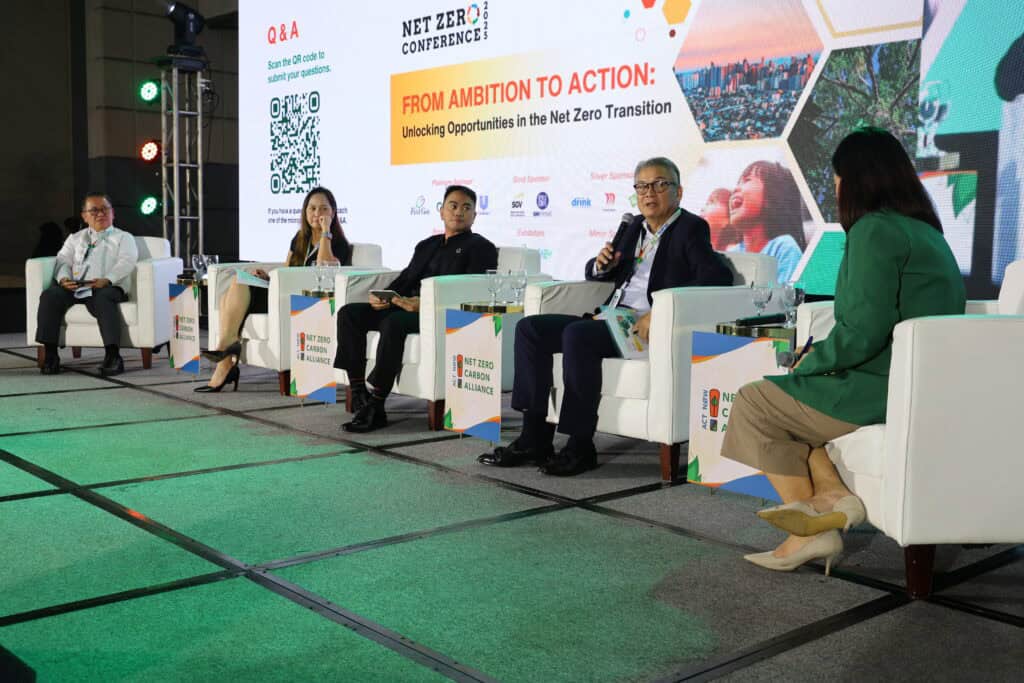
Alba’s call was reinforced by other voices in the plenary session.
Energy Secretary Sharon Garin said the country is on track to reach a renewable energy share of 35 percent by 2030 and 50 percent by 2040, but admitted challenges remain. She said projects still face a permitting process that can take three to five years.
“We cannot have clean but unaffordable energy,” Garin said. “Our task is to make sure projects are executed on time and at the right price.”
Rondell Torres, Unilever’s sustainability lead for the Philippines and Greater Asia, said the company shifted its Philippine operations to geothermal energy through a partnership with First Gen and is now encouraging its suppliers to follow suit. He stressed that big companies can help smaller ones move toward cleaner operations by sharing knowledge and creating demand for renewable power.
Francis Giles Puno, vice chairman and CEO of the Energy Development Corporation (EDC), explained that EDC made a deliberate choice not to invest in coal even when it was the cheaper option. Instead, the company expanded geothermal energy, which provides a steady 24/7 supply without the emissions that come from fossil fuels. Puno said this early decision positioned EDC to lead in the clean energy transition.
Why this matters for Filipinos
For ordinary households, Alba said, climate action is not an abstract policy but a matter of everyday life. Shifting to renewable energy and protecting forests can mean:
- Lower electricity bills through efficiency and renewable supply.
- Cleaner air and fewer health problems from reduced air pollution.
- Safer homes and communities, since trees and forests help prevent floods and landslides.
“The Philippines cannot afford to wait,” Alba concluded. “Early action is the smartest economic choice we can make.”
What is the Net Zero Carbon Alliance?
The Net Zero Carbon Alliance (NZCA) is a pioneering coalition launched in 2021 by First Gen Corporation to help Philippine businesses reduce their carbon emissions and achieve net zero. It brings together companies from different industries and provides them with tools, strategies, and partnerships tailored to their resources and needs.
In just four years, NZCA has grown to 41 private sector partners, reflecting the increasing commitment of businesses to environmental responsibility while keeping operations sustainable. Each year, it hosts the Philippine Net Zero Conference, a platform for knowledge-sharing, sectoral engagement, and collaborative action.
The 2025 edition of the conference, its second, expanded its focus beyond ambition-setting to equipping businesses with the practical solutions and partnerships needed to deliver on their climate pledges. New features included “CDx Fishbowl Sessions,” interactive discussions designed to surface real-world strategies and peer-to-peer learning.
By creating a space where government, business, and civil society leaders can meet and collaborate, the alliance aims to turn climate promises into tangible, measurable action.
This year’s plenary, anchored by Alba’s warning on the cost of delay, showed that while challenges remain, early action through forests, energy efficiency, and clean power is not only possible but also the smartest path for the Philippines to protect lives, jobs, and its economic future.
